# Unit 3: Major Prophets (2)
# Week1: The Call of Jeremiah and His Mission
Introduction and chapter 1
**Week 1: The Call of Jeremiah and His Mission**
**The History of Humanity from Adam to the End of the World**
[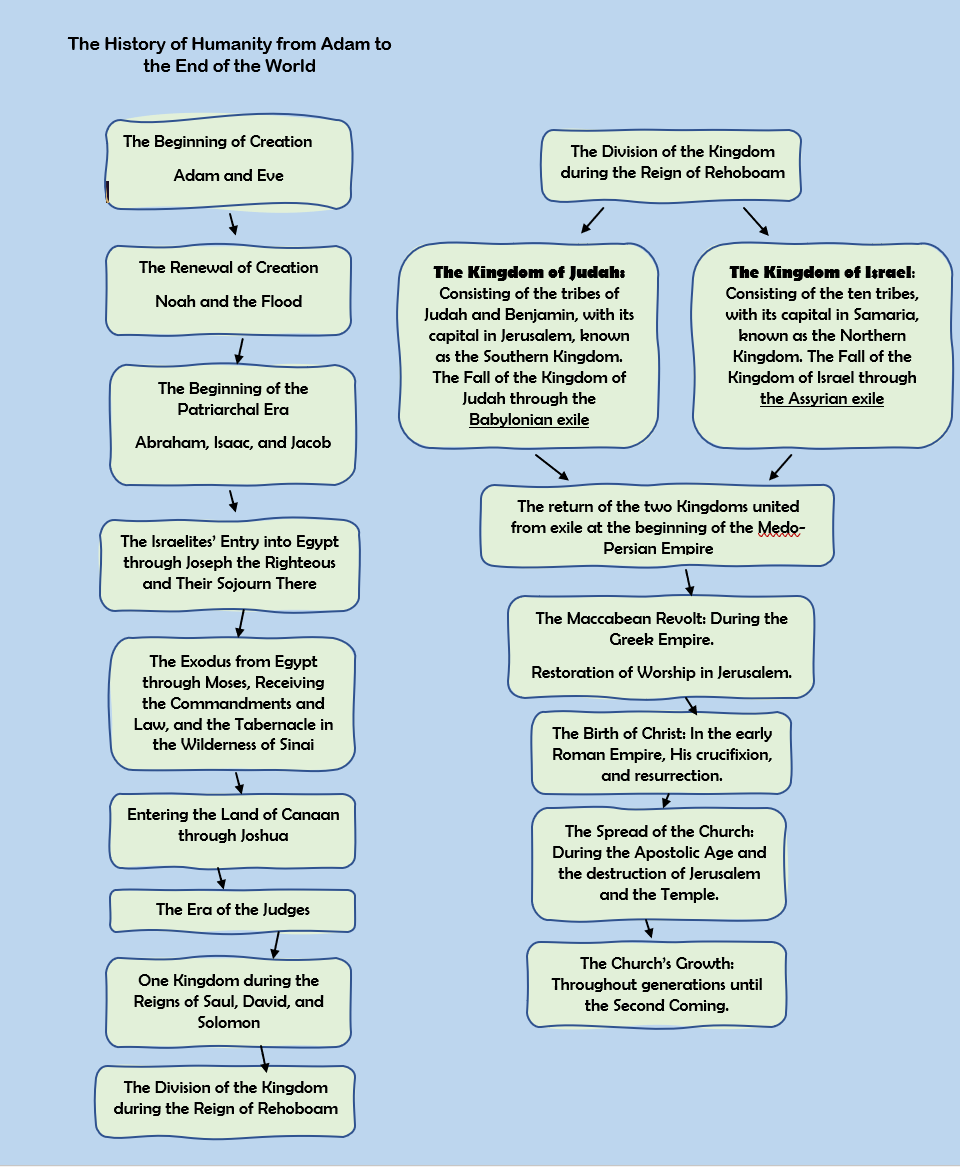](https://service.strebekahorlando.org/uploads/images/gallery/2024-09/image-1726950490251.png)
**Introduction: Jeremiah the Prophet:**
- The Old Testament contains 17 prophetic books (Splits into major and minor prophets based on the size of the book)
- Major Prophets (5 books): Isaiah, Jeremiah, Lamentations, Ezekiel, and Daniel
- Minor Prophets (12 books): Hosea, Joel, Amos, Obadiah, Jonah, Micah, Nahum, Habakkuk, Zephaniah, Haggai, Zechariah, and Malachai
- **Time of Birth:**
- Jeremiah was born in the mid-seventh century BC during the reign of the wicked King Manasseh. Coming from a priestly family, Jeremiah was familiar with the Law and God’s works among His people. Having lived during the reigns of the wicked Manasseh and his equally wicked son Amon, Jeremiah witnessed the moral and spiritual corruption of both the king and the people. God later called him to confront these evils.
- The prophet Baruch was Jeremiah's disciple, who recorded many of his prophecies.
- **Place of Birth:**
- Jeremiah was born in the village of Anathoth, located northeast of Jerusalem
- **God’s Call:**
- God called Jeremiah to service through a vision when he was still young. His mission was to rebuke the evil of the king, leaders, priests, and people.
- Jeremiah lived a celibate life as commanded by the Lord.
- **Titles:**
- **The Weeping Prophet**: Known for his intense emotions, Jeremiah wept over the sins of those around him.
- **The Job of the Prophets**: Jeremiah endured intense suffering, including rejection by his people, betrayal by his own brother, physical torture, and imprisonment.
**The Book of Jeremiah:**
**Author:** The name Jeremiah means "Yahweh exalts," signifying that God glorifies.
**Introduction:**
- Jeremiah addressed the Jews living in the southern kingdom, which consisted of the tribes of Judah and Benjamin, with Jerusalem as their capital.
- The people, led by corrupt leaders and wicked kings, were deeply sinful. Their unrepentance resulted in the Babylonian captivity and the destruction of Jerusalem and the temple.
- Jeremiah's message was a call to repentance, urging them to rely on God
**Date:**
- Jeremiah began his prophetic ministry in 626 BC, during King Josiah's reforms, and served for over 40 years. Despite being forcibly taken to Egypt, he continued urging repentance and faithfulness to God until his martyrdom by stoning in Egypt.
Jeremiah the prophet lived during the reigns of several kings
- Manasseh the Wicked
- Amon the Wicked
- Josiah the Righeous
- Jehoahaz the Wicked
- Jehoiakim (brother of Jehoahaz) the Wicked
- Jehoiachin
- Zedekiah
**How Did the Babylonian Captivity Happen?**
- As the Assyrian Empire weakened, King Josiah of Jerusalem gained independence but was killed by Necho, king of Egypt, in the Battle of Megiddo.
- Necho deposed Josiah's son Jehoahaz, replacing him with Jehoiakim, who taxed the people heavily to pay tribute to Egypt.
- Nebuchadnezzar defeated Necho, leading Jehoiakim to ally with Babylon. Jeremiah warned against reliance on Egypt and urged repentance.
- Nebuchadnezzar captured Jerusalem, exiled King Jehoiachin, and installed Zedekiah as king.
The Babylonian captivity occurred in three stages:
- 605 BC, during King Jehoiakim’s reign (Daniel and the three young men were exiled)
- 597 BC, during King Jehoiachin’s reign (Great Exile, Ezekiel and Mordecai exiled)
- 587 BC, When King Zedekiah was captured and exiled to Babylon (Jeremiah was exiled)
- After Zedekiah's exile, the King of Babylon came and burned the temple and destroyed the walls of Jerusalem.
**Objectives of the Book of Jeremiah:**
- Call to Repentance: Urging the people to return to God.
- God’s Discipline and Mercy: Highlighting that God disciplines His children when they sin but also affirms His mercy.
- Need for the Messiah: Pointing to the hope of the coming Savior.
- Spiritual Principles:
- Sin is a breach of the covenant with God.
- All sins against others are ultimately offenses against God.
- Times of hardship should lead to self-examination and renewed commitment to God.
**Outline:**
- The Call of Jeremiah and His Mission (Chapter 1).
- Prophecies Before the Fall of Jerusalem and the Promise of Return from Exile (Chapters 2–33).
- The History of the Fall of Jerusalem (Chapters 34–45).
- Prophecies Concerning the Nations (Chapters 46–51).
- Conclusion: Review of the Events of the Exile (Chapter 52).
**Reading:**
The Book of Jeremiah: Chapter 1
**Outline**:
- Introduction to the Prophet and the History of His Prophethood (1:1-3)
- The Call of Jeremiah (1:4-10)
- Vision of a Branch of Almond tree and the Boiling Pot (1:11-16):
- Jeremiah's Responsibility (1:17-19)
**Resources:**
- [Father Luke Maher - Audio (Arabic)](https://www.youtube.com/watch?v=pDaDKE0u-cM&list=PLQ2-BTI8z3FN9QGbwKcIfrRJoURXwFngX)
- [Father Dawood Lemay- Audio (Arabic)](https://www.youtube.com/watch?v=xHkPy6VEYBA&list=PLTaOEtFd-qVE372ZZnt-RugJL-N14RdQb)
- Commentary on the Book of Jeremiah (English) Fr. Tadros Malaty. PDF: [024\_Jeremiah.pdf](https://service.strebekahorlando.org/attachments/16)
**Key verse(s):**
"They will fight against you, But they shall not prevail against you. For I am with you, says the Lord, to deliver you.." Jeremiah 1:19
**Comments**:
1. Introduction to the Prophet and the History of His Prophethood (1:1-3)
- Prophet Jeremiah: son of Hilkiah the priest, born in Anathoth (tribe of Benjamin).
- Beginning of his writing during the reign of King Josiah over Judah (capital: Jerusalem).
- The Kingdom of Judah included the tribes of Judah and Benjamin.
- Jeremiah’s prophethood continued during the reigns of Kings Jehoiakim and Zedekiah.
- The exile occurred in the 11th year of Zedekiah's reign.
2. The Call of Jeremiah (1:4-10)
- God's message began to Jeremiah, informing him that he was chosen for service even before he was formed in his mother's womb.
- "He chose us in Him before the foundation of the world, that we should be holy and without blame before Him in love" (Ephesians 1:4).
- Contemplation: God loved us and consecrated us to live for Him. We shouldn’t become distracted by worldly concerns and deviate from Him through many sins, but we should please Him in everything and serve Him faithfully.
- Jeremiah expressed his inability to carry out God’s call to him, referring to himself as "a youth," meaning he was younger than thirty, the age at which Jews considered a man fully mature. This is the same age at which Jesus began His ministry. But God supported Jeremiah and promised to save him and be with him to complete his service.
- God touched Jeremiah’s lips to give him the strength to speak God’s word.
3. Vision of a Branch of Almond tree and the Boiling Pot (Jeremiah 1:11-16):
- Branch of Almont Tree: The first vision given to Jeremiah is of an almond rod, which symbolizes God's watchfulness and care. The almond tree appears lifeless in winter but bears fruit in spring. God watches His people but their sin will lead to punishment if they don’t repent.
- The Boiling Pot: The second vision that Jeremiah saw was a boiling pot, which symbolizes the pride of the Jews. They believed that as long as the temple of God was among them and they had outward forms of personal worship, no harm would come to them. However, the pot's mouth facing north symbolizes the Babylonian attack from the north on Jerusalem and Judah, leading to its occupation and destruction.
- The visions remind God's people to heed His word, repent, and avoid neglecting His commands, lest they face punishment.
4. Jeremiah's Responsibility (1:17-19)
- God reminded him that the most important fear is of God, not the fear of people.
- God promised to make Jeremiah:
- Fortified City: to be protector to those who fear him
- Iron Pillar: strong foundation
- Bronze Wall: protection from oppositions of th wicked
**Review/recap questions:**
\*\*Servant may add more questions
- List Major and minor prophets? What's the difference between them?
- Who is the prophet Jeremiah?
- How Did the Babylonian Captivity Happen?
- What was God response to Jeremiah when he said “I cannot speak for I am a youth”?
- What is the meaning of the two visions of Jeremiah?
**Homework**:
\*\*Servant may add more questions
- Before I \_\_\_\_\_\_ you in the womb, I \_\_\_\_\_\_ you. Before you were \_\_\_\_\_\_ -I sanctified you. I ordained you a \_\_\_\_\_\_ to the nations."
- What are the two visions of Jeremiah?. Explain
- "Do not say I am a youth." Who said this sentence? To whom? Why?
# Week 2 - Jeremiah - Warnings about the coming exile and calls to repentance
**Introduction: Jeremiah the Prophet:**
- The Old Testament contains 17 prophetic books (Splits into major and minor prophets based on the size of the book)
- Major Prophets (5 books): Isaiah, Jeremiah, Lamentations, Ezekiel, and Daniel
- Minor Prophets (12 books): Hosea, Joel, Amos, Obadiah, Jonah, Micah, Nahum, Habakkuk, Zephaniah, Haggai, Zechariah, and Malachai
- **Time of Birth:**
- Jeremiah was born in the mid-seventh century BC during the reign of the wicked King Manasseh. Coming from a priestly family, Jeremiah was familiar with the Law and God’s works among His people. Having lived during the reigns of the wicked Manasseh and his equally wicked son Amon, Jeremiah witnessed the moral and spiritual corruption of both the king and the people. God later called him to confront these evils.
- The prophet Baruch was Jeremiah's disciple, who recorded many of his prophecies.
- **Place of Birth:**
- Jeremiah was born in the village of Anathoth, located northeast of Jerusalem
- **God’s Call:**
- God called Jeremiah to service through a vision when he was still young. His mission was to rebuke the evil of the king, leaders, priests, and people.
- Jeremiah lived a celibate life as commanded by the Lord.
- **Titles:**
- **The Weeping Prophet**: because of his sorrow over the fall of Jerusalem, Jeremiah prophesied before, during, and after the Babylonian exile
- **The Job of the Prophets**: Jeremiah endured intense suffering, including rejection by his people, betrayal by his own brother, physical torture, and imprisonment.
- **Quick Summary**
- Jeremiah's prophecies primarily focused on the coming Babylonian exile. He urged the people of Judah to repent so they could avoid destruction, but unfortunately, they ignored his warnings.
- He faced rejection from his family, the people, and the kings, such as Manasseh, Amon, and Zedekiah, who were all evil rulers. Despite the hardships, including being thrown into a pit and imprisoned, Jeremiah remained steadfast in his prophetic mission.
- Jeremiah also prophesied during the reign of Josiah, a righteous king, and even though there was hope during this time, the people continued in idol worship, which led to their eventual downfall.
- When the exile came, the temple and Jerusalem were destroyed. Jeremiah wept over the destruction and wrote the Book of Lamentations. Though he was initially rejected by the people, he continued to deliver God's messages and witnessed the fulfillment of his prophecies with the Babylonian conquest.
- Jeremiah's calling to ministry
- he was called by God to be a prophet. God told him, "Before I formed you in the womb, I knew you; before you were born, I sanctified you; I ordained you a prophet to the nations" (Jeremiah 1:5).
When God called him, Jeremiah felt unworthy, being a young man, but God reassured him, saying, "Do not say, 'I am a youth'; for you shall go to all to whom I send you, and whatever I command you, you shall speak." God promised that He would be with him and would protect him from harm.
- Jeremiah's challenges
- Throughout his ministry, Jeremiah faced opposition from the kings of Judah, including Jehoiakim and Zedekiah, who rejected his message. Despite this, Jeremiah continued to deliver God's word, even warning that Babylon would conquer Judah. Eventually, the people, especially those left behind after the Babylonian exile, fled to Egypt, where they continued to engage in idol worship. Jeremiah followed them to Egypt, where he was again rejected and stoned by his own people, ultimately dying a martyr’s death.
**Objectives of the Book of Jeremiah:**
- Call to Repentance: Urging the people to return to God.
- God’s Discipline and Mercy: Highlighting that God disciplines His children when they sin but also affirms His mercy.
- Need for the Messiah: Pointing to the hope of the coming Savior.
- Spiritual Principles:
- Sin is a breach of the covenant with God.
- All sins against others are ultimately offenses against God.
- Times of hardship should lead to self-examination and renewed commitment to God.
**Outline:**
- The Call of Jeremiah and His Mission (Chapter 1).
- Prophecies Before the Fall of Jerusalem and the Promise of Return from Exile (Chapters 2–33).
- The History of the Fall of Jerusalem (Chapters 34–45).
- Prophecies Concerning the Nations (Chapters 46–51).
- Conclusion: Review of the Events of the Exile (Chapter 52).
**Reading:**
- The Book of Jeremiah chapters 2-29
- Call to repentance
- Chapter 2:1-8
- Chapter 3: 12-19
- Temple Sermon
- Chapter 7:1-10
- The weeping prophet
- Chapter 9:1
- New Covenant
- Chapter 11:1-14
- Prayer of Jeremiah
- Chapter 14:7-9
- The good and bad figs
- Chapter 24:1-10
- Babylonian Exile:
- Chapter 25: 1-14
- **Outline**:
- Call to repentance and hatred of sin. Chapters 2&3
- Jeremiah wars against false confidence in the temple and empty rituals. Chapter 7
- New covenant and God's judgement for disobedience. Chapter 11
- The vision of the good and bad figs (faithful and rebellious people). Chapter 24
- The prophecy of 70 years of Babylonian captivity as a consequences of disobedience. Chapter 25
**Resources:**
- [Father Luke Maher - Audio (Arabic)](https://www.youtube.com/watch?v=pDaDKE0u-cM&list=PLQ2-BTI8z3FN9QGbwKcIfrRJoURXwFngX)
- [Father Dawood Lemay- Audio (Arabic)](https://www.youtube.com/watch?v=xHkPy6VEYBA&list=PLTaOEtFd-qVE372ZZnt-RugJL-N14RdQb)
- Commentary on the Book of Jeremiah (English) Fr. Tadros Malaty. PDF: [024\_Jeremiah.pdf](https://service.strebekahorlando.org/attachments/16)
- **Key verse(s):**
"For I know the plans I have for you, declares the Lord, plans to prosper you and not to harm you, plans to give you hope and future." Jeremiah 29:11
- **Comments**
- **Call to repentance and hatred of sin. Chapters 2&3**
- Chapter 2:1-8
- God warns Jerusalem so that it may repent because they forsake Him and worshipped other gods and He remind them how He led them out of Egypt and guided them in the wilderness.
- Chapter 3: 12-19
- In his prophecy, he demonstrates how Israel can repent, summarized as follows:
- Returning to God (verse 12): There is no solution to their problems except through faith in God and living with Him.
- Trusting in God’s mercy (verse 12): He is very compassionate and forgiving.
- Examining oneself (verse 13): To recognize one’s sin.
- Obeying God (verse 14) : Sin is disobedience to Him.
- Trusting in one’s sonship to God (verse 14): Rejecting sins that anger Him.
- Recognizing God as the Only King of the heart (verse 15): He solves all problems, restores Israel from exile, and thus requires repentance to resolve issues.
- **Blessings of repentance**
- He gives them shepherds: priests and teachers who are obedient to Him, speak His word
- Prophecy about Christianity, when believers in Christ multiply in the New Testament Church
- Return from the exile
- Receiving the grace of sonship
- **Jeremiah wars against false confidence in the temple and empty rituals. Chapter 7**
- Chapter 7:1-10
- In the early chapters of this book, Jeremiah speaks among the people, calling them to repentance. However, now he stands publicly in the most important place—the gate of the house of the Lord, the holy temple in Jerusalem—where crowds gather to worship and bow before God. There, he rebukes everyone: the people, the leaders, and the priests
- God requires His people—so that He may keep them in the holy land, the Promised Land—to do the following:
- Uphold justice in their dealings.
- Avoid oppressing the vulnerable, such as the stranger, the orphan, and the widow.
- Refrain from shedding innocent blood to achieve their ambitions and gain.
- Stay away from idol worship.
- **The weeping prophet:**
- Chapter 9:1
- **New covenant and God's judgement for disobedience. Chapter 11**
- Chapter 11:1-14
- God calls His people in the kingdom of Judah through Jeremiah to renew their covenant with Him.
- Consequences of breaking the covenant: As a result of the people breaking their covenant with God, they deprive themselves of His care and protection. They face great distress, including the Babylonian invasion and exile. When they call out to God, He will not answer them due to their immersion in evil and idol worship.
- **Prayer of Jeremiah**
- Chapter 14:7-9
- The prophet Jeremiah bears the sins of his people and offers this prayer, confessing on their behalf and acknowledging their weakness. He admits that they have sinned against God and deserving of punishment.
- **The vision of the good and bad figs (faithful and rebellious people). Chapter 24**
- Chapter 24:1-10
- The presence of the two baskets in front of the house of God signifies the positioning of the Jews, of various kinds, before God to be judged.
- The two types represent the righteous Jews and the wicked Jews. The first group consists of those who obeyed God, went into exile, and followed His commandments. The second group, the wicked ones, are those who remained in Jerusalem.
- God promises those who obeyed Him and went into exile that He will bless them for accepting His discipline. He will reward them by bringing them back to Jerusalem, establishing them there, and rebuilding the temple.
- The prophecy of 70 years of Babylonian captivity as a consequences of disobedience. Chapter 25
- Chapter 25: 1-14
- Jeremiah speaks about the Babylonian invasion, which is coming to destroy Jerusalem and warns the people for the last time, urging them to repent. The duration of the exile is seventy years
**Review/recap questions:**
\*\*Servant may add more questions
- List Major and minor prophets? What's the difference between them?
- Who is the prophet Jeremiah?
- What was the prayer of Jeremiah about?
- Why was Jeremiah call the weeping prophet? what was his message?
- What does each basket of figs symbolize?
**Homework**:
\*\*Servant may add more questions
- Where did the Lord ask Jeremiah to stand and proclaim His words? Chapter 7
- Having wept continuously what does Jeremiah desire to have and why? Chapter 9:1
- What were the words of the covenant between God and Israel? Chapter 11:7
- What do the cities of Judah offer to the gods? Chapter 11:12
a) gold b) myrrh c) incense d) money
- O LORD, though our \_\_\_\_\_\_\_\_\_\_ testify against us, Do it for Your\_\_\_\_\_\_; for our backslidings are many, We have \_\_\_\_\_\_against you. Chapter 14:7
- Who do the bad figs represent?
- For how long will the nations serve the King of Babylon?
# Week 3 - The Promise of return from Exile + Book of Lamentations
**Introduction: Jeremiah the Prophet:**
- The Old Testament contains 17 prophetic books (Splits into major and minor prophets based on the size of the book)
- Major Prophets (5 books): Isaiah, Jeremiah, Lamentations, Ezekiel, and Daniel
- Minor Prophets (12 books): Hosea, Joel, Amos, Obadiah, Jonah, Micah, Nahum, Habakkuk, Zephaniah, Haggai, Zechariah, and Malachai
- **Time of Birth:**
- Jeremiah was born in the mid-seventh century BC during the reign of the wicked King Manasseh. Coming from a priestly family, Jeremiah was familiar with the Law and God’s works among His people. Having lived during the reigns of the wicked Manasseh and his equally wicked son Amon, Jeremiah witnessed the moral and spiritual corruption of both the king and the people. God later called him to confront these evils.
- The prophet Baruch was Jeremiah's disciple, who recorded many of his prophecies.
- **Place of Birth:**
- Jeremiah was born in the village of Anathoth, located northeast of Jerusalem
- **God’s Call:**
- God called Jeremiah to service through a vision when he was still young. His mission was to rebuke the evil of the king, leaders, priests, and people.
- Jeremiah lived a celibate life as commanded by the Lord.
- **Titles:**
- **The Weeping Prophet**: because of his sorrow over the fall of Jerusalem, Jeremiah prophesied before, during, and after the Babylonian exile
- **The Job of the Prophets**: Jeremiah endured intense suffering, including rejection by his people, betrayal by his own brother, physical torture, and imprisonment.
- **The Book of Lamentations:**
- **Author:** The prophet Jeremiah
- **Time of writing:** Immediately after the fall of Jerusalem in 587 BC
- **Place of writing:** Jerusalem
- **Purpose of the book:**
- To emphasize God’s justice, which must prevail as punishment for sin
- Call for repentance
- Offer hope in God's mercy and seeking forgiveness
- **Sections:** It was written in poetic form across five chapters
**Outline:**
- **Chapters 30–33**: Prophecies of hope and restoration, the New Covenant, and God's promises to bring His people back from exile.
- **Chapters 34–45**: Historical events surrounding the exile, including the fall of Jerusalem and the destruction of the temple.
- **Chapters 46–52**: Prophecies against the nations, including Egypt and Babylon.
- **Book of Lamentations: Chapter 1-5**
- **Chapter 1:** Jerusalem, the weeping widow
- **Chapter 2:** God's wrath upon Jerusalem
- **Chapter 3:** Lamentations over God's discipline of His people
- **Chapter 4:** Discipline followed by judgement
- **Chapter 5:** Seeking God's mercy
**Reading:**
- The Book of Jeremiah chapters 30-52
- Prophecies of hope and restoration, the New Covenant, and God's promises to bring His people back from exile.
- Read Jeremiah Chapter 30: 1-11
- Read Jeremiah Chapter 31: 1-11, 31-34
- The fall of Jerusalem and the destruction of the temple.
- Read Jeremiah Chapter 52: 12-23
- The Book of Lamentations
- - Read chapter 3:22-33
- **Outline**:
**Resources:**
- [Father Luke Maher - Audio (Arabic)](https://www.youtube.com/watch?v=pDaDKE0u-cM&list=PLQ2-BTI8z3FN9QGbwKcIfrRJoURXwFngX)
- [Father Dawood Lemay- Audio (Arabic)](https://www.youtube.com/watch?v=xHkPy6VEYBA&list=PLTaOEtFd-qVE372ZZnt-RugJL-N14RdQb)
- Commentary on the Book of Jeremiah (English) Fr. Tadros Malaty. PDF: [024\_Jeremiah.pdf](https://service.strebekahorlando.org/attachments/16)
- [Father Dawood-Book of Jeremiah](https://www.youtube.com/watch?v=CWccWNaBbhg)
- [Father Dawood-Book of Lamentations](https://www.youtube.com/watch?v=UcbCXtR0Rc0)
- **Key verse(s):**
"You shall be My people, and I will be your God." Jeremiah 30:22
- **Comments**
- **Hope and restoration of Israel**
- **Jeremiah Chapters 30-33**God tells Jeremiah to write his prophecies in a book because this is not the end of Israel, but rather a period of discipline. Afterward, God will visit them, bring them back from captivity, and this time of discipline will lead to Israel's repentance. God, in His mercy, will visit those who will seek Him and will restore their captivity.
- Here’s how God will arrange this:
- Discipline: Chapter 30:11
After the people's corruption, God will deliver them into captivity through Babylon.
- Mercy: chapter 31:3-4
In His mercy, God will gather His people and bring them back from captivity. God will not only restore them but also bless them abundantly, leading them to praise Him with all their hearts.
- Repentance: Chapter 31:9-10
In response to all this, a person can only thank God for His blessings, understand the reason for the trial, and give thanks for it.
- The Coming of Christ: Chapter 33:15
The new David—the King who will reign forever.
- The New Covenant: Chapter 31:31-34
The New Covenant of grace, salvation, and the work of the Holy Spirit in our hearts.
- **The fall of Jerusalem and the destruction of the temple.**
- **Jeremiah chapters 34-45**
- God instructed Jeremiah to warn King Zedekiah that Jerusalem will fall to the Babylonians and the city will be burned
- Jeremiah instructed Baruch to write down a scroll of prophecies, warning of Jerusalem's destruction, but King Jehoiakim burns the scroll, rejecting God's message.
- Baruch is a Hebrew name meaning "blessed." He was a disciple of Jeremiah and recorded his prophecies. After this, he went to Babylon and wrote a book of his own "Book of Baruch), which is part of the Deuterocanonical books.
- Then, Jeremiah was thrown into prison by the officials for prophesying that the Babylonians will capture Jerusalem.
- Jeremiah was then thrown into a dungeon, but was rescued later by Ebed-Melech, Ethiopian eunuch and was brought back the King Zedekiah.
- Jeremiah prophesied again to King Zedekiah that surrendering to the Babylonians is the only way to survive." Chapter 38:17
- The Babylonians break through the city walls, capturing Jerusalem. After the fall of Jerusalem, the Babylonian captain of the guard, Nebuzaradan, released Jeremiah from prison and gave him freedom.
- The people asked Jeremiah to pray to the Lord for guidance to flee to Egypt. God warned them not to go to Egypt, as it will lead to their destruction. They refuse to listen.
- Jeremiah rebuked the people for continuing to worship idols in Egypt, despite God’s previous judgment on Judah.
- **Prophecy about the fall of Babylon and return from Exile**
- **Chapters 50-52**
- God declares judgment on Babylon for its arrogance and idolatry.
- Israel and Judah are promised redemption and restoration.
- (Recap) The fall of Jerusalem and destruction of the Temple. Chapter 52
- **Book of Lamentations:**
- In the 12th hour of Good Friday, we read Chapter 3:1-66 from the book of Lamentations, commemorating the burial of Christ after His death on the cross. This chapter serves as a symbol of Christ, crushed with sufferings for our sake, we who are sinners.
- Chapter 3:22-33
- Jeremiah sees the grace bestowed upon him, recognizing that although many of God’s people have perished and the remaining have suffered greatly, the entire nation has not been destroyed. The sins of the people warranted the death of all, but God’s mercies preserved a remnant of His people, giving them the opportunity to repent so that He may bless them.
**Review/recap questions:**
\*\*Servant may add more questions
- - God promises that Israel's captivity is not the end but a period of discipline. He assures their return, repentance, and restoration through His mercy.
- Jeremiah warns of the fall of Jerusalem due to the people's sin and disobedience.
- God declares judgment on Babylon for its arrogance and idolatry while promising redemption and restoration for Israel and Judah.
- The Book of Lamentations (Read on Good Friday) Chapter 3:1-66 is read during the Twelfth Hour. It reflects on God's mercy, and offers hope in repentance and restoration.
**Homework**:
\*\*Servant may add more questions
- - “You shall be My \_\_\_\_\_\_\_, And I will be \_\_\_\_\_\_\_ God” Jeremiah 30:22
- With whom will God make His new covenant? chapter 31
- David was before the time of Jeremiah so what does God mean by “David their king whom I will
raise up for them.” Chapter 30
- Which chapter of the book of Lamentations do we read on Good Friday? in which hour?
# Week 4 - Baruch
**Introduction:**
- The book of Baruch is one of the Deuterocanonical books, which the Orthodox church considers as part of the Old Testament.
- These books were written by the Jews in the exile after the time of Ezra and were included in the Septuagint translation of the Bible and many other early translations of the Bible, including the first Coptic translation. These books are:
- Tobit - 14 chapters
- Judith - 16 Chapters
- The remainder of the book of Esther - Chapters 10 to 16.
- The Wisdom of Solomon - 19 chapters.
- Joshua the son of Sirach - 51 chapters
- The Prophecy of Baruch - 6 chapters
- The remainder of Daniel, which include the rest of chapter 3 and chapters 13and 14.
- The first Maccabees - 16 chapters
- The second Maccabees - 15 chapters
- Psalm 151
- **Author:**
- - The author is Baruch. The name "Baruch" is a Hebrew word meaning "Blessed,"
Baruch was born around 626 BC in Judah. He saw with his own eyes the Babylonian exile, the destruction of Jerusalem, and the temple.
Baruch was a disciple of the prophet Jeremiah and a scribe who recorded his prophecies. He remained obedient to Jeremiah throughout his life. Even when the Jews took Jeremiah to Egypt, Baruch followed him, witnessing Jeremiah’s martyrdom by stoning.
Baruch went to Babylon, where he began writing and proclaiming prophecies. He lived to see the fulfillment of these prophecies when the exiles returned under Zerubbabel.
- **Time and place of writing:**
- Baruch wrote it after his arrival in Babylon, following the martyrdom of Jeremiah, five years after the burning of Jerusalem and the temple.
- **To whom it was written:**
- Baruch wrote it to the exiled Jews in Babylon
- **Purpose of the book:**
- To reject the idolatrous worship
- Call for repentance
- To comfort the exiled Jews and encourage them to adhere to God’s commandments and remain steadfast in Him
- To proclaim Jeremiah’s message to the exiles, urging them to avoid idols and live with God, who would bring them back from exile.
- **Sections:**
- Historical introduction (Baruch 1:1-14).
- Confession of sin (Baruch 1:15-3:8).
- Acceptance of discipline and return to the law (Baruch 3:9-4:20).
- Joy in salvation (Baruch 4:21-5).
- Message of the prophet Jeremiah (Baruch 6).
- **Prophecies:**
- **The Church and Eternity:** A prophecy about the covenant God will make with His people in Christ the Redeemer and the Church of the New Covenant (Baruch 2:35).
- **The Incarnation:** The incarnation of Christ in the fullness of time (Baruch 3:36-38).
- **Victory over the Babylonians and Satan**: The destruction of the enemies who enslaved God’s people (Baruch 4:25).
- **Return from Exile:** Rejoicing in Jerusalem (Baruch 4:37; 5:5,9).
**Reading:**
- **Prayer of repentance .**
- **Confession of sins. (Baruch 1:17-22, 2:5-13)**
- **Seeking mercy and salvation, (Baruch 2:14–19, 3:1-5).**
- **Praise and thanksgiving, (Baruch 3:6-7).**
- **Prophecy about the church and eternity: (Baruch 2:35)**
- **Acceptance of discipline and return to the law** (Baruch 3:9-14, 31-38).
- **Joy in salvation** (Baruch 4:21-27).
- **Return from exile** (Baruch 5:1-9).
**Resources:**
- [Fr. Antonios Fekry Bible study of the Book of Baruch](https://coptic-treasures.com/chapter/baruch-006-st-mark-cleopatra/ "Fr. Antonios Fekry Bible study of the Book of Baruch")
- [Fr. Dawood Lamaay Arabic sermon](https://www.youtube.com/watch?v=WZYbaQ4D2Yw "Fr. Dawood Lamaay Arabic ")
- [Fr. Luka Maher: Arabic sermon about Minor Prophets part 1](https://www.youtube.com/watch?v=44E1Vfg7b48&t=259s "Fr. Luka Maher: Arabic sermon about Minor Prophets part 1")
**Key verse(s):**
- "Take off, O Jerusalem, the garment of your sorrow and troubles, and put on your beauty and honor of that eternal glory, which you have from God." Baruch 5:1
**Comments:**
- - **Prayer of repentance (Baruch 1:15-3:8).**
Baruch teaches us how to pray. Prayer begins with confession, where we acknowledge our sins. Then comes seeking mercy and salvation, knowing that God forgives. Finally, prayer includes praise and thanksgiving, as we acknowledge God’s greatness.
This part contains a deep prayer of repentance, this prayer begins from (Baruch 1:15 – 3:8).
**This prayer includes three important spiritual themes**:
1. **Confession of sins. Read Baruch 1:17-22, 2:5-13**
Baruch acknowledges that their exile and suffering are just consequences of their disobedience to God's law.
2. **Seeking mercy and salvation, as in (Baruch 2:14–19, 3:1-5).**
Baruch asks God for mercy to forgive their sins and to remember His covenant with their ancestors.
3. **Praise and thanksgiving, as in (Baruch 3:6-7).**
Baruch transitions to praising God
The beginning of any restoration is repentance and confession to receive the mercy of God.
- **The Church and Eternity:** A prophecy about the covenant God will make with His people in Christ the Redeemer and the Church of the New Covenant (Baruch 2:35). This is a clear prophecy about the Church, The covenant mentioned by Baruch here was referred to by Jeremiah as the "New Covenant" (Jeremiah 31:31-34).
Here, Israel represents the Church. The land that God gave to His people is His Church on earth. The covenant is a promise that God will grant His Church an eternal heavenly inheritance.
- **Acceptance of discipline and return to the law (3:9-14, 31-38).**
The focus in this part is to accept discipline and return to God’s law as the source of wisdom and life. Baruch reminds us that wisdom cannot be found in earthly knowledge but only in God, who is the ultimate source of wisdom.
- - **The Incarnation:** Prophecy about the incarnation of Christ in the fullness of time (Baruch 3:36-38).
These verses are a prophecy about the Incarnation, when God sent His only Son to take on human flesh, dwell among us, bring salvation and redemption, and show us His love and care.
- **Joy in salvation (Baruch 4:21-27).**
- This section describe the people’s recognition that the suffering they went through was a result of their disobedience, but now, with repentance and God’s mercy, they will rejoice in the salvation He offers.
- **Victory over the Babylonians and Satan:** Prophecy about the destruction of the enemies who
enslaved God’s people (Baruch 4:25).
- **Return from exile: Prophecy** about the return from exile and rejoicing in Jerusalem (Baruch 5: 1-9)
- **Message of the prophet Jeremiah (Baruch 6).**
- It is stated at the beginning of this chapter that it is a message from God, written by the prophet Jeremiah, and given to those who would be exiled to Babylon. This message was then included at the end of Baruch's prophecy, who was a disciple and scribe of Jeremiah. This message is a warning to the exiled Jews not to be influenced by the idol worship widespread in Babylon. It cautions them against worshiping idols or sins, such as adultery.
**Review/recap questions:**
\*\*Servant may add more questions
- What are the Deuterocanonical books?
- Who is Baruch?
- Review the purpose of the book and the prophecies
**Homework**:
\*\*Servant may add more questions
- To whom did Baruch read this Book?
- How did God punish Israel?
- The people will be captive in Babylon for:
a) seven years b) seventy years c) seven generations d) forever